jrootham.ca
Economics of Private Landlords
Summary and Recommendations
Expecting competition to force private landlords to efficiently provide housing fails because markets will only drive rent down to the costs of new construction, not the (much lower) costs of existing buildings.
This not only directly causes affordability issues but also creates a very large wealth transfer from renters to landlords.
Over the (long) life of a rental building the capital costs are almost irrelevant. The mortgage payments get eroded by inflation and drop to zero when the mortgage is paid off. In significant parts of the private market rents do not follow costs.
Since the new programs from the federal government include offering long amortization mortgages I have included that option in this analysis. It does offer some potential relief for renters, but does not reduce long term profitability that much.
The solution to this problem is enough non profit housing to remove the market power of private landlords. This housing does not need to be subsidized, it just needs to charge only enough to cover its costs. It does not matter if the housing is owned directly by the government, is a not for profit co-op, or is owned by a not for profit organization.
Exactly how this gets implemented is beyond the scope of this paper. Given that there are multiple possible solutions, there will be multiple future papers exploring the options.
About Jim Rootham
Jim Rootham has been the chair of the finance committee of his co-op for most of the last 40 years. He is a computer programmer by trade. He spent some time in the financial industry, where he learned about financial instruments. He is mostly self taught in Political Economy.
Rental Economics
Introduction
This paper describes a high level model of cost and rents for rental buildings. It only deals with buildings with relatively high attractiveness (near median rents and above), since those are the ones with policy salience.
A fundamental assumption is that building life is measured in decades or centuries.
Costs
The absolute value of the costs specified below are very loose estimates. The key point in the analysis is how they change over time.
The cost structure for rental buildings has three categories: Mortgage; Operating; Replacement Reserves.
Mortgage
I do not know of any generally accepted long term model for interest rates.
The model used here assumes that the Bank of Canada hits its target rate for inflation and interest rates are therefore constant. This is clearly false in the short term, but is a reasonable long term assumption.
The mortgage costs assume a total capital cost of $400,000 with an 85% mortgage (15% down payment) at 6% interest with a 25 or 50 year amortization period.
Operating
Operating costs include taxes, utilities, employees, maintenance, and others. The simplifying assumption here is to estimate the costs at startup and have them increase by inflation every year. As with the mortgage model the assumption assumes that the Bank of Canada hits its inflation rate target (2%).
The operating costs are derived from the experience of my co-op.
Replacement Reserves
Replacement reserves are money saved to pay for large maintenance items. To estimate them properly requires a building condition assessment to determine the timing of the replacement and a financial plan to determine the saving rate.
The simplified plan here starts with an estimate and inflates it every year by the expected inflation for large repairs, which at 3.5% is higher than the assumed 2% general inflation rate.
The 3.5% is from the current replacement reserve study for my co-op. The starting value is an estimate.
Total Costs
The sum of the three categories.
Profitability
Location, location, location also applies to rentals, so we have desirable locations and undesirable locations.
In this analysis we assume desirable locations and profit maximization on the part of the owners. This is what Econ 101 claims is the wonderful solution. Older buildings are massively profitable.
Given that future profits can be much higher than current profits it may involve flipping properties. In this case current profits may be relatively low because they have already been captured by the price paid for the building.
Rents
In the charts below the rent estimates (start just below costs and increase by the inflation rate) are very conservative.
Margins
The margins are the rents minus the total costs.
Charts
The charts are about cash flow, they do not include more complex calculations of profit and loss.
Graphs of nominal dollar flows
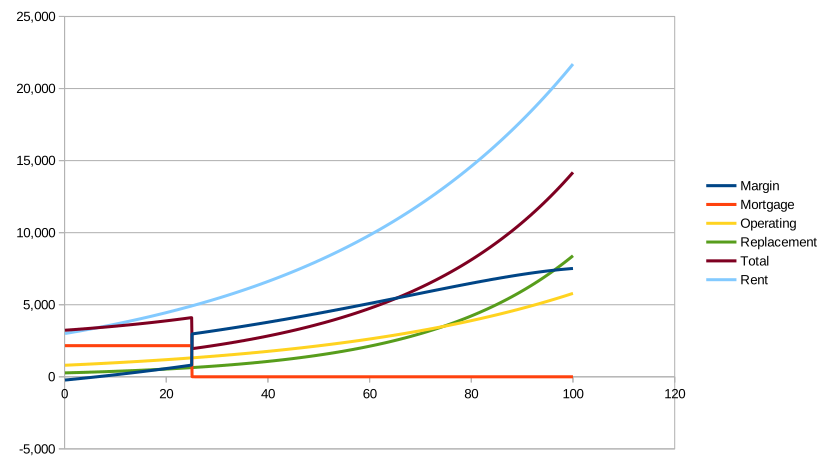
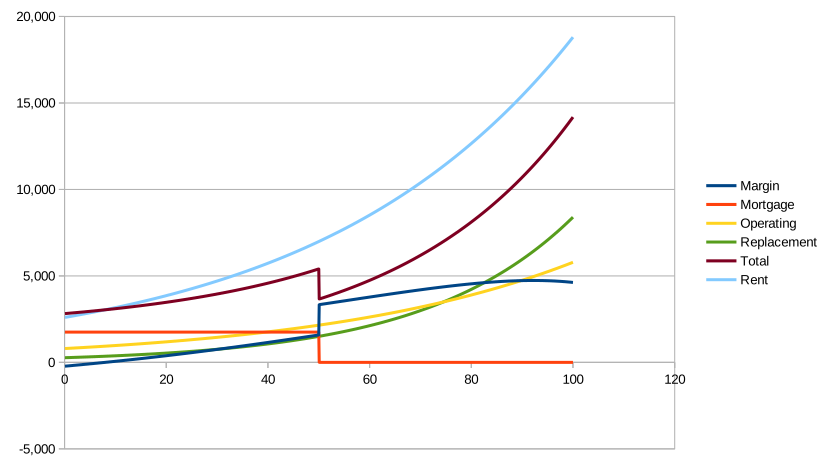
The nominal dollar charts are best interpreted as the history of a typical rental project.
Here is the first option: $2,900 rent and 25 year amortization period.
Here is the second option: $2,600 rent and 50 year amortization period.
Graphs of constant dollar flows
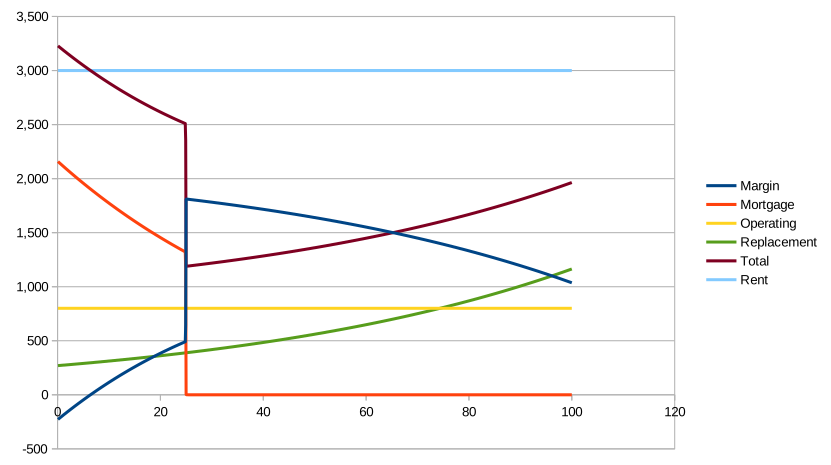
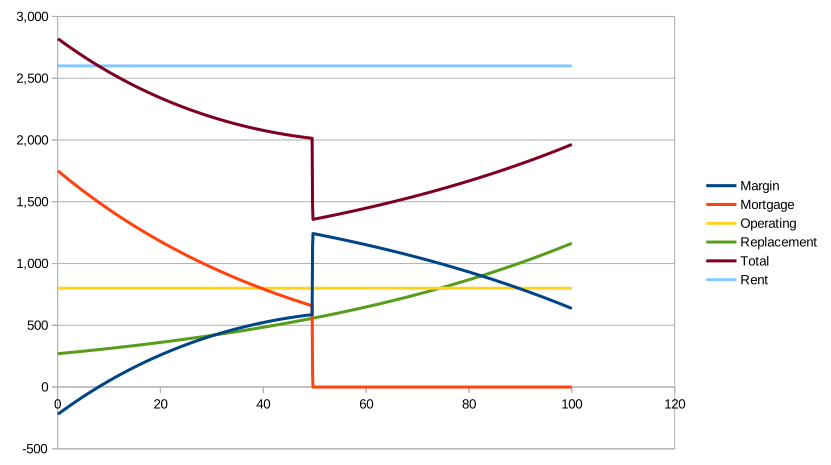
The constant dollar charts are best interpreted as the typical cash flow this year of a unit built that many years ago.
Here is the first option: $2,900 rent and 25 year amortization period.
Here is the second option: $2,600 rent and 50 year amortization period.
Discussion
The most obvious point about how costs change over time is the drop in costs when the mortgage is paid off.
The other notable point is how replacement reserves gradually dominate costs.
On the income side it is notable how big the profits get.
For a 25 year amortization period if we look at the folowing table of Net Present Value (NPV) for each assumed interest rate we note that the total ranges from about $1,250,000 to about $150,000 dollars for a $60,000 investment, depending on a (reasonable) interet rate assumption.
The Internal Rate of Return (IRR) (the interest rate that drops the NPV to zero) is about 15%. This is about twice the expected rate of a stock index.
For a 50 year amortization period the returns are somewhat lower, although the IRR is close, this woould suggest that profitability has a sensitive dependence on IRR.
These should be considered lower bounds on the rate of return because of the conservative rent increases in the model.
| Interest | 25 year value | 50 year value |
|---|---|---|
| 2.00% | 1,273,774 | 758,585 |
| 4.00% | 440,709 | 234,827 |
| 6.00% | 176,254 | 84,961 |
| 8.00% | 76,567 | 34,248 |
| 10.00% | 33,567 | 14,171 |
| 12.00% | 13,126 | 5,084 |
| 14.00% | 2,738 | 514 |
| 16.00% | -2,776 | -1,965 |
Conclusions
There are several things we can see from this analysis.
-
Over the (long) life of a project the initial capital costs are almost irrelevant.
-
Large scale maintenance costs eventually dominate the cost structure.
-
Over a long enough timescale rental properties accumulated profits are astoundingly large.